Nattokinase is a serine protease enzyme extracted from natto, a traditional Japanese food made by fermenting soybeans with Bacillus subtilis. Unlike many supplement enzymes that never make it past the digestive tract intact, research in human plasma suggests nattokinase retains measurable fibrinolytic activity after oral ingestion, breaking down fibrin directly and stimulating the body’s own plasminogen activators.[1] This has generated genuine scientific interest, particularly around cardiovascular applications.
Dosage is where nattokinase conversations get complicated. Products are sold in milligrams, capsule counts, and a specialized unit called the FU — Fibrinolytic Unit — and the numbers on labels vary widely. This guide explains what FU units actually measure, what dose ranges appear in small human trials, how timing may matter, and who should approach nattokinase with caution or avoid it altogether. Nothing here is medical advice, and the FDA has not evaluated nattokinase for treating, curing, or preventing any disease.
Key Takeaways
- FU (Fibrinolytic Units) is the relevant potency measure for nattokinase — milligrams alone do not indicate enzyme activity.
- Human research has generally used doses between 2,000 and 4,000 FU per day; 2,000 FU is a common starting point.
- Taking nattokinase on an empty stomach — before meals or between meals — is the standard recommendation to limit protease degradation.
- Nattokinase must not be combined with warfarin, aspirin, clopidogrel, or other anticoagulants or antiplatelets without physician supervision due to additive bleeding risk.
- Human trials are small and short-term; the FDA has not evaluated nattokinase for any disease, and this information is not medical advice.
What Are FU Units and Why They Matter More Than Milligrams
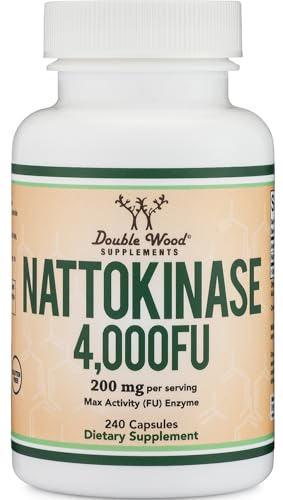
When you pick up a nattokinase supplement, you may see the dose listed as 100 mg, 2,000 FU, or both. The milligram figure tells you how much powder is in the capsule. The FU figure — Fibrinolytic Unit — tells you how enzymatically active that powder is. Because enzyme potency depends heavily on extraction method, fermentation conditions, and storage, two products with identical milligram counts can have dramatically different fibrinolytic activity.
FU (sometimes written as fibrinolysis units or fibrin degradation units) are determined by standardized in-vitro assays that measure how quickly a sample dissolves a fibrin clot under controlled conditions. A higher FU count indicates greater clot-dissolving capacity per unit of enzyme. This is the number that actually corresponds to the doses used in human research, making it the relevant figure when comparing products or evaluating whether a dose is in a clinically studied range.
As a practical rule: always look for FU on the label. If a product only lists milligrams with no activity unit, you have no way to judge potency. Reputable manufacturers typically standardize to at least 2,000 FU per capsule, which aligns with the lower end of doses that have been studied in small human trials.
Dose Ranges Used in Human Research
Human trials on nattokinase are small and short-term — this is a consistent limitation across the field, and any claims of proven efficacy for specific health conditions go beyond what the current evidence supports. That said, the studies that do exist have generally used doses between 2,000 FU and 4,000 FU per day[2], often given as a single daily dose or split into two doses. Some investigations examining blood pressure effects have used the lower end of this range[3], while fibrinolytic marker studies have sometimes used higher amounts.[4]


A dose of 2,000 FU daily appears to be the most commonly used starting point in published research.[5] Doses above 4,000 FU per day have been used in some protocols[6], but there is no strong clinical evidence that higher amounts produce proportionally greater benefit, and the risk of bleeding-related adverse effects increases with dose, particularly in people taking other blood-thinning agents. The available human data does not yet define a minimum effective dose or a clear dose-response curve with confidence.
Timing: When to Take Nattokinase for Best Absorption
Nattokinase is a protein-based enzyme, and like most enzymes taken orally, it is susceptible to degradation by proteases in the stomach and small intestine. Taking nattokinase on an empty stomach — typically 30 to 60 minutes before a meal or at least two hours after eating — is the most commonly recommended timing, based on the rationale that lower protease activity in a fasted state may allow more enzyme to reach the bloodstream intact.
Some practitioners suggest taking nattokinase before bed, reasoning that overnight represents a prolonged fasting window and that fibrinolytic activity may be particularly relevant during the early morning hours when cardiovascular events are statistically more common. However, this timing recommendation is based on physiological reasoning rather than controlled head-to-head trial data. Morning fasted dosing is equally defensible. What the evidence does not support is taking nattokinase with a protein-rich meal, where competing digestive proteases are abundant.
If splitting a daily dose of 4,000 FU into two doses of 2,000 FU, a common approach is to take one dose in the morning before breakfast and one in the evening before dinner, maintaining consistent fasting windows around both doses.
How Nattokinase Works: The Proposed Mechanism
Nattokinase degrades fibrin — the insoluble protein scaffold that forms blood clots — through direct enzymatic cleavage. It also appears to upregulate endogenous tissue plasminogen activator (tPA) and urokinase, the body’s own fibrinolytic enzymes, and may downregulate plasminogen activator inhibitor-1 (PAI-1), which normally suppresses clot dissolution.[7] This multi-pronged effect on the fibrinolytic system distinguishes nattokinase from simpler anticoagulants.
Beyond fibrinolysis, laboratory and small human studies have examined nattokinase’s antiplatelet properties — the ability to reduce platelet aggregation[8] — and modest effects on blood pressure, potentially through bradykinin potentiation. These mechanisms are biologically plausible and supported by in-vitro and some human plasma data, but it bears repeating: the clinical trials in humans are small, often uncontrolled, and short in duration. Extrapolating these findings to specific health outcomes requires caution.
Safety Considerations, Drug Interactions, and Contraindications
Nattokinase has meaningful fibrinolytic and antiplatelet activity, which means it carries real bleeding risk in the wrong context. It must not be combined with warfarin, heparin, aspirin, clopidogrel, rivaroxaban, apixaban, dabigatran, or any other anticoagulant or antiplatelet medication without direct physician supervision. The additive effect on clot prevention can substantially increase the risk of serious bleeding, including intracranial hemorrhage.[9] This is not a theoretical concern — it is a pharmacologically predictable interaction.

Nattokinase should be discontinued at least one week before any surgical procedure, dental extraction, or invasive diagnostic procedure. Individuals with a history of stroke (particularly hemorrhagic stroke), bleeding disorders, active peptic ulcers, or clotting factor deficiencies should not take nattokinase without explicit medical guidance. Pregnant women and individuals with serious kidney or liver conditions should also consult a physician before use.
Natto — the food from which nattokinase is derived — contains vitamin K2, which has pro-coagulant effects. Most purified nattokinase supplements are processed to remove vitamin K, which is important for anyone on warfarin therapy. Confirm with the manufacturer that the product is vitamin K-free if this applies to you. Even vitamin K-free products carry the fibrinolytic risk described above and remain contraindicated with anticoagulants.
Practical Dosing Summary and Realistic Expectations
For healthy adults considering nattokinase as a general supplement, the most evidence-aligned starting range is 2,000 FU per day taken on an empty stomach. Some people step up to 4,000 FU per day after assessing tolerance. There is no established optimal dose, and individual response likely varies based on diet, baseline fibrinolytic activity, genetics, and other factors that no current trial has adequately characterized.
Realistic expectations matter. Nattokinase is not a proven treatment for any cardiovascular condition. The most honest summary of the evidence is that small, short-term human studies have shown measurable changes in fibrinolytic markers and modest blood pressure reductions in some populations. Whether these translate to meaningful long-term clinical outcomes is not established.[10] Anyone using nattokinase should do so as part of a broader approach to cardiovascular health — not as a standalone solution — and should inform their healthcare provider.
Supplement quality varies considerably. Look for products that list FU activity on the label, are manufactured under GMP-certified conditions, and have been third-party tested. Enteric-coated capsules are marketed as protecting the enzyme from stomach acid, though the evidence that enteric coating meaningfully improves bioavailability for nattokinase specifically is not firmly established.
🛒 Where to Buy Nattokinase
- Doctor’s Best Nattokinase 2,000 FULab-tested / studied
capsules, 100 mg NSK-SD per vcap (2,000 FU) — Most widely referenced brand in clinical and integrative medicine contexts; uses Japan Bio Science Laboratory NSK-SD ingredient; vegetarian capsules; 90 count - NOW Foods Nattokinase 100 mg
capsules, 100 mg per vcap (2,000 FU) — Mainstream GMP-certified brand; affordable entry-level option; 90 vcaps; widely available - Source Naturals Nattokinase 100 mg
capsules, 100 mg per tablet (2,000 FU) — Long-established supplement brand; competitive pricing at 60 tablets; good for budget-conscious buyers familiar with the brand - Healthy Origins Nattokinase 2,000 FU
capsules, 100 mg per vcap (2,000 FU) — Best cost-per-serving option on Amazon; 180 vcap bottle; uses NSK-SD ingredient; popular bulk buy for long-term users
As an Amazon Associate we earn from qualifying purchases. Nattokinase is sold on an enzymatic activity claim, and independent testing has repeatedly found bottles delivering well under their labelled potency. Check that the label states fibrinolytic units (FU) per capsule rather than milligrams alone, and prefer a brand that will supply a batch-specific certificate of analysis showing the measured FU result for that lot, since GMP certification alone does not verify it.
A Note on the Evidence
The human clinical evidence for nattokinase is limited to small, short-term trials, and the FDA has not approved or evaluated it for any disease or health condition; this article is informational only and does not constitute medical advice. Anyone taking anticoagulants, antiplatelets, or blood pressure medications, or who has a cardiovascular, bleeding, or clotting condition, must consult a qualified healthcare provider before using nattokinase.

Frequently Asked Questions
What does FU mean on a nattokinase supplement label?
FU stands for Fibrinolytic Unit, a standardized measure of how quickly the enzyme dissolves a fibrin clot in a controlled laboratory assay. It reflects actual enzymatic potency rather than just the weight of powder in the capsule. Always choose products that display an FU count so you can make meaningful comparisons between brands.
Is 2,000 FU or 4,000 FU a better dose?
Most small human studies have used doses in the 2,000–4,000 FU range. Starting at 2,000 FU per day is a common, conservative approach. There is no current clinical evidence that higher doses within this range consistently produce better outcomes, and higher doses theoretically increase bleeding risk, particularly for anyone taking other medications that affect clotting.
Can I take nattokinase if I'm on a blood thinner?
No, not without direct physician supervision. Nattokinase has real fibrinolytic and antiplatelet activity that adds to the effects of warfarin, heparin, aspirin, clopidogrel, and newer anticoagulants like rivaroxaban or apixaban. Combining them raises the risk of serious or life-threatening bleeding. Always disclose all supplements to your prescribing physician.
Should I take nattokinase with food or on an empty stomach?
An empty stomach is generally recommended — 30 to 60 minutes before a meal or at least two hours after eating. The reasoning is that digestive proteases present during active food digestion may break down the enzyme before it can be absorbed. Some people prefer a fasted dose before bed, though direct comparative timing trials in humans are lacking.
How long does it take for nattokinase to work?
In human plasma studies, fibrinolytic activity has been detected within a few hours of a single dose. Short-term trials examining blood pressure effects have typically run for 8 to 12 weeks before reporting results. There is no established timeline for any specific clinical benefit, and individual variation is likely substantial. Long-term safety data beyond a few months of supplementation is limited.
Does nattokinase contain vitamin K?
Natto, the fermented soybean food, is a significant source of vitamin K2. Most purified nattokinase supplements are processed to remove vitamin K, which is important for people on warfarin whose therapy depends on stable vitamin K intake. Always verify with the manufacturer that a specific product is vitamin K-free, and inform your doctor regardless, since the fibrinolytic effect of nattokinase itself remains a concern independent of vitamin K content.
References
- A single-dose of oral nattokinase potentiates thrombolysis and anti-coagulation profiles. Sci Rep (2015). PMID 26109079
- Nattokinase Supplementation and Cardiovascular Risk Factors: A Systematic Review and Meta-Analysis of Randomized Controlled Trials. Rev Cardiovasc Med (2023). PMID 39076715
- Effects of nattokinase on blood pressure: a randomized, controlled trial. Hypertens Res (2008). PMID 18971533
- Nattokinase decreases plasma levels of fibrinogen, factor VII, and factor VIII in human subjects. Nutr Res (2009). PMID 19358933
- Consumption of nattokinase is associated with reduced blood pressure and von Willebrand factor, a cardiovascular risk marker: results from a randomized, double-blind, placebo-controlled, multicenter North American clinical trial. Integr Blood Press Control (2016). PMID 27785095
- Effective management of atherosclerosis progress and hyperlipidemia with nattokinase: A clinical study with 1,062 participants. Front Cardiovasc Med (2022). PMID 36072877
- Role of Fibrinolytic Enzymes in Anti-Thrombosis Therapy. Front Mol Biosci (2021). PMID 34124160
- Nattokinase improves blood flow by inhibiting platelet aggregation and thrombus formation. Lab Anim Res (2013). PMID 24396387
- Cerebellar hemorrhage provoked by combined use of nattokinase and aspirin in a patient with cerebral microbleeds. Intern Med (2008). PMID 18310985
- Nattokinase atherothrombotic prevention study: A randomized controlled trial. Clin Hemorheol Microcirc (2021). PMID 33843667
These statements have not been evaluated by the Food and Drug Administration. This information is not intended to diagnose, treat, cure, or prevent any disease. Content is for informational purposes only and is not medical advice; consult a qualified healthcare provider before starting any supplement. As an Amazon Associate we earn from qualifying purchases.
