Nattokinase is a serine protease enzyme derived from natto, a traditional Japanese food made by fermenting soybeans with Bacillus subtilis. Unlike most dietary supplements, nattokinase has a well-characterized biochemical mechanism: it degrades fibrin directly and appears to upregulate endogenous plasminogen activators, the body’s own clot-dissolving proteins. This dual action has made it a subject of genuine scientific interest among researchers studying alternatives or adjuncts to conventional thrombolytic approaches.
The evidence base for nattokinase in humans is real but modest. Most supportive trials are small, short-term, and not replicated at the scale required for clinical approval. The FDA has not evaluated nattokinase for treating, curing, or preventing any disease. What follows is an honest summary of what the published research actually shows, grounded in the available human and preclinical data, without extrapolating beyond what the studies support.
Key Takeaways
- Nattokinase is a serine protease from Bacillus subtilis-fermented soybeans that degrades fibrin directly and may upregulate the body’s own plasminogen activators, giving it a biologically plausible fibrinolytic mechanism.
- A small human trial found that nattokinase supplementation significantly reduced plasma fibrinogen, factor VII, and factor VIII, which are coagulation proteins tied to clot formation [1].
- Preclinical animal studies support thrombolytic activity in vivo [2], but animal data does not reliably predict human clinical outcomes.
- Nattokinase must not be combined with warfarin, heparin, aspirin, clopidogrel, or other anticoagulants or antiplatelets without physician supervision, and should be stopped at least one week before surgery.
- Human trials remain small and short-term; the FDA has not approved nattokinase for treating, curing, or preventing any disease, and this information is not medical advice.
How Nattokinase Produces Fibrinolytic Effects: The Mechanism
Fibrin is the structural protein scaffold of a blood clot. When a clot forms, thrombin converts soluble fibrinogen into insoluble fibrin strands that cross-link and trap platelets. Dissolving a clot therefore requires breaking down this fibrin network, a process called fibrinolysis. The body accomplishes this mainly through plasmin, an enzyme activated from plasminogen by tissue plasminogen activator (tPA) and urokinase.
Nattokinase acts on fibrin through at least two pathways. First, it cleaves fibrin directly, acting as a serine protease in a manner analogous to plasmin itself. Second, research suggests it can stimulate the release or upregulation of endogenous plasminogen activators, effectively amplifying the body’s own fibrinolytic system. This combination is part of why nattokinase has attracted attention beyond simpler proteolytic enzymes. A broad review of microbial fibrinolytic enzymes noted that nattokinase demonstrates in vitro and in vivo fibrinolytic activity comparable to or exceeding that of several other bacterial proteases studied for thrombolytic potential [3].
It is worth noting that oral bioavailability of large proteins is typically low, since digestive enzymes degrade them. Researchers have proposed that nattokinase survives partial gastrointestinal transit due to its relative stability at acidic pH and its relatively modest molecular weight compared to streptokinase or tPA. However, the precise fraction of orally administered nattokinase that reaches the bloodstream in active form remains an open question in the literature.
Human Evidence: Changes in Fibrinogen and Coagulation Factors
The most directly relevant human data comes from a randomized trial that measured plasma levels of specific coagulation proteins after nattokinase supplementation. Subjects taking nattokinase showed significant decreases in plasma fibrinogen, factor VII, and factor VIII compared to controls [1]. These three proteins are each important in different parts of the coagulation cascade: fibrinogen is the direct precursor to fibrin, factor VII initiates the extrinsic coagulation pathway, and factor VIII amplifies thrombin generation. Reductions in all three represent a measurable shift in the coagulation-fibrinolysis balance toward less clot formation and potentially greater clot breakdown.


This study is notable because it used human subjects and measured biomarkers directly tied to fibrinolytic and anticoagulant activity, rather than relying solely on animal models or in vitro assays. However, the trial was small and relatively short in duration, and it is not clear whether these biomarker changes translate into clinically meaningful reductions in thrombotic events. Changes in plasma fibrinogen, factor VII, and factor VIII are surrogate markers, not direct measures of reduced stroke or deep vein thrombosis risk. Larger, longer, outcomes-based trials in humans have not yet been conducted.
Preclinical Evidence: Thrombolytic Effects in Animal Models
Animal studies provide a controlled environment for testing whether nattokinase can actually dissolve established clots, something harder to measure ethically in healthy human volunteers. In a carrageenan-induced rat thrombosis model, nattokinase administration produced measurable thrombolytic effects in vivo, reducing clot burden compared to untreated controls [2]. Carrageenan induces localized thrombosis and inflammation, making it a standard preclinical tool for evaluating anticoagulant and fibrinolytic compounds.
Animal models like this are valuable for establishing mechanism and dose-response relationships, but they do not reliably predict human outcomes. Rats metabolize compounds differently than humans, and carrageenan-induced thrombosis does not replicate the pathophysiology of arterial atherosclerotic clots or venous thromboembolic disease in people. These findings support the biological plausibility of nattokinase as a fibrinolytic agent but should not be interpreted as proof of clinical efficacy in humans.
Nattokinase in Context: Microbial Fibrinolytic Enzymes
Nattokinase belongs to a broader family of microbial fibrinolytic enzymes that have been studied as potential alternatives to pharmaceutical thrombolytics such as streptokinase and tPA. A comprehensive overview of this enzyme class noted that nattokinase, derived from Bacillus subtilis fermentation, stands out for its oral activity, relatively low production cost, and demonstrated fibrinolytic and anticoagulant properties in multiple study formats [3]. Other enzymes in this class include lumbrokinase (from earthworms) and various Bacillus-derived proteases.
The appeal of microbial fibrinolytic enzymes relative to pharmaceutical thrombolytics is that the latter are intravenous agents used in acute care settings with significant bleeding risks. Oral enzymes like nattokinase are being explored for preventive or low-risk contexts, though it must be emphasized that no microbial fibrinolytic enzyme has been approved by the FDA for thrombolytic therapy. The distinction between a supplement with fibrinolytic activity and an approved thrombolytic drug is not merely regulatory; it reflects real gaps in rigorous clinical evidence.
Emerging Research: Novel Delivery Approaches and Recombinant Forms
Researchers have begun exploring ways to enhance nattokinase’s fibrinolytic potency and delivery. One line of investigation involves recombinant engineering: an N-terminal-truncated recombinant form of a related fibrinolytic serine protease demonstrated improved anticoagulant and plasma defibrinogenation activity in rodent models, along with preclinical safety data, suggesting that protein engineering may offer a path to more potent or better-tolerated variants [4].

A separate area of research involves combining nattokinase with other agents for targeted delivery. An intravenous nattokinase-heparin electrostatic complex was studied in the context of advanced tumor-associated thrombosis, with findings suggesting that dissolving cancer-related fibrin networks improved therapeutic outcomes in that preclinical context [5]. This research is preliminary and involves intravenous administration in a cancer model, making it far removed from the context of oral supplementation for cardiovascular support. It does, however, illustrate that nattokinase’s fibrinolytic properties are being actively studied for specialized applications beyond general wellness.
These emerging approaches are worth noting as indicators of scientific interest, but they are not a basis for claims about what commercially available oral nattokinase supplements do. Recombinant proteins and intravenous complexes are not the same as standard nattokinase capsules, and extrapolating from these studies to supplement efficacy would be inaccurate.
Safety Considerations, Drug Interactions, and Who Should Avoid Nattokinase
Nattokinase has meaningful fibrinolytic and antiplatelet activity. This is precisely what makes it biologically interesting, and precisely what creates real safety considerations. Anyone taking anticoagulant or antiplatelet medications, including warfarin, heparin, aspirin, clopidogrel, rivaroxaban, apixaban, or similar drugs, should not take nattokinase without explicit physician supervision. Combining multiple agents that reduce clotting increases bleeding risk in a non-additive way that is difficult to predict or monitor without clinical oversight.
Nattokinase should be discontinued at least one week before any surgical procedure. Even minor reductions in fibrinogen and coagulation factors, as documented in human trials [1], can meaningfully affect surgical bleeding. Individuals with bleeding disorders, a history of hemorrhagic stroke, or active peptic ulcer disease face elevated risk and should avoid nattokinase entirely unless directed otherwise by a physician. Pregnant or breastfeeding individuals should also consult a physician before use, as there is insufficient safety data for these populations.
🛒 Where to Buy Nattokinase
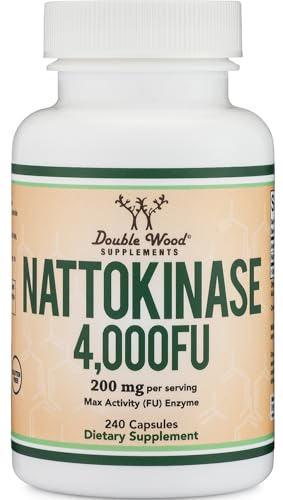
- Doctor’s Best Nattokinase 2,000 FULab-tested / studied
capsules, 100 mg NSK-SD per vcap (2,000 FU) — Most widely referenced brand in clinical and integrative medicine contexts; uses Japan Bio Science Laboratory NSK-SD ingredient; vegetarian capsules; 90 count - NOW Foods Nattokinase 100 mg
capsules, 100 mg per vcap (2,000 FU) — Mainstream GMP-certified brand; affordable entry-level option; 90 vcaps; widely available - Source Naturals Nattokinase 100 mg
capsules, 100 mg per tablet (2,000 FU) — Long-established supplement brand; competitive pricing at 60 tablets; good for budget-conscious buyers familiar with the brand - Healthy Origins Nattokinase 2,000 FU
capsules, 100 mg per vcap (2,000 FU) — Best cost-per-serving option on Amazon; 180 vcap bottle; uses NSK-SD ingredient; popular bulk buy for long-term users
As an Amazon Associate we earn from qualifying purchases. Nattokinase is sold on an enzymatic activity claim, and independent testing has repeatedly found bottles delivering well under their labelled potency. Check that the label states fibrinolytic units (FU) per capsule rather than milligrams alone, and prefer a brand that will supply a batch-specific certificate of analysis showing the measured FU result for that lot, since GMP certification alone does not verify it.
A Note on the Evidence
The human evidence for nattokinase consists primarily of small, short-term trials measuring surrogate biomarkers, not clinical outcomes; results should not be generalized beyond what those specific studies showed. Nattokinase has real fibrinolytic and antiplatelet activity and is contraindicated alongside anticoagulants, antiplatelets, and before surgery — anyone with a clotting disorder, cardiovascular condition, or current medication regimen should consult a physician before use.

Frequently Asked Questions
What does 'fibrinolytic activity' mean in plain terms?
Fibrinolytic activity refers to the ability to break down fibrin, the protein that forms the structural scaffold of a blood clot. Nattokinase can cleave fibrin directly as a serine protease and may also boost the body’s own clot-dissolving enzymes. A review of microbial fibrinolytic enzymes confirmed nattokinase demonstrates this activity in multiple study formats [3].

Has nattokinase been tested in human beings, or only in animals?
Both. A human trial measured coagulation biomarkers before and after nattokinase supplementation and found significant decreases in plasma fibrinogen, factor VII, and factor VIII [1]. Animal studies have also shown thrombolytic effects in induced thrombosis models [2]. However, the human trials are small and short-term, and outcomes-based trials demonstrating reduced thrombotic events in people have not been conducted.
Can nattokinase replace blood thinners like warfarin?
No. Nattokinase is a dietary supplement and has not been approved by the FDA to treat, prevent, or cure any disease, including thrombosis. Warfarin and similar anticoagulants are prescription medications with carefully monitored dosing and established clinical evidence. Substituting nattokinase for a prescribed anticoagulant without physician guidance could result in dangerous under-treatment of a serious condition.
Why should nattokinase not be combined with aspirin or clopidogrel?
Nattokinase has both fibrinolytic and antiplatelet activity. Aspirin and clopidogrel are also antiplatelet agents. Combining multiple antiplatelet or anticoagulant agents amplifies bleeding risk beyond what any single agent would produce, and this combined effect is difficult to predict or monitor safely outside of medical supervision. Human data showing reductions in coagulation factors [1] supports that nattokinase produces real physiological changes that interact with these drug mechanisms.
What does the research on nattokinase-heparin complexes show?
Researchers studied an intravenous nattokinase-heparin electrostatic complex in a preclinical model of advanced tumor-associated thrombosis and found it improved therapeutic outcomes by dissolving cancer-related fibrin networks [5]. This is an early-stage, intravenous, disease-specific application that is not equivalent to oral nattokinase supplementation; it illustrates that nattokinase’s fibrinolytic properties are being studied for specialized clinical contexts, but these findings do not apply directly to supplement use.
Are there engineered or recombinant forms of nattokinase being developed?
Yes. Researchers have studied an N-terminal-truncated recombinant fibrinolytic serine protease that showed improved anticoagulant and defibrinogenation activity in rodent models along with preclinical safety data [4]. Protein engineering approaches aim to improve potency and tolerability, but these recombinant variants are distinct from the nattokinase found in commercially available supplements and are not currently available as consumer products.
References
- Hsia CH et al. Nattokinase decreases plasma levels of fibrinogen, factor VII, and factor VIII in human subjects. Nutrition research (New York, N.Y.) (2009). PMID 19358933
- Xu J et al. Thrombolytic effects in vivo of nattokinase in a carrageenan-induced rat model of thrombosis. Acta haematologica (2014). PMID 24862625
- Peng Y et al. Microbial fibrinolytic enzymes: an overview of source, production, properties, and thrombolytic activity in vivo. Applied microbiology and biotechnology (2005). PMID 16211381
- Bora B et al. The N-terminal-truncated recombinant fibrin(ogen)olytic serine protease improves its functional property, demonstrates in vivo anticoagulant and plasma defibrinogenation activity as well as pre-clinical safety in rodent model. International journal of biological macromolecules (2018). PMID 29292153
- Wang D et al. Intravenous injection of nattokinase-heparin electrostatic complex improves the therapeutic effect of advanced tumors by dissolving cancer-related thrombosis. Life sciences (2024). PMID 39094906
These statements have not been evaluated by the Food and Drug Administration. This information is not intended to diagnose, treat, cure, or prevent any disease. Content is for informational purposes only and is not medical advice; consult a qualified healthcare provider before starting any supplement. As an Amazon Associate we earn from qualifying purchases.
