Blood viscosity — the resistance of blood to flow — is a physiological variable that affects how efficiently oxygen and nutrients reach tissues. When blood becomes abnormally thick or when red blood cells clump together excessively, circulation can be impaired at the microvascular level. Hemorheology is the scientific field that studies these flow properties, and researchers have begun examining whether enzymes with fibrinolytic activity might influence them.
Nattokinase is a serine protease derived from natto, a traditional Japanese food made from soybeans fermented with Bacillus subtilis. It is best known for its ability to break down fibrin — the protein scaffold of blood clots — and to upregulate the body’s own clot-dissolving mechanisms. Because fibrin and fibrinogen also influence blood viscosity and red blood cell aggregation, some researchers have investigated whether nattokinase supplementation might affect hemorheological parameters. What follows is an honest summary of what that research currently shows.
Key Takeaways
- Nattokinase is a fibrinolytic enzyme from fermented soybeans that degrades fibrin and reduces circulating fibrinogen — proteins that directly influence red blood cell aggregation and blood viscosity.
- A published hemorheology study examined nattokinase’s effects on red blood cell aggregation and whole blood viscosity, making it the primary direct evidence in this specific area [1].
- The current evidence base for nattokinase’s hemorheological effects is limited: human studies are small, short-term, and not yet widely replicated.
- Nattokinase must not be combined with warfarin, heparin, aspirin, clopidogrel, or other anticoagulants or antiplatelets without physician supervision due to additive bleeding risk.
- This information is not medical advice; anyone considering nattokinase supplementation — particularly those with cardiovascular conditions or on blood-thinning medications — should consult a qualified healthcare provider first.
What Is Hemorheology and Why Does Blood Viscosity Matter?
Hemorheology is the study of the deformation and flow of blood and its formed elements — primarily red blood cells (erythrocytes), white blood cells, and platelets — as they move through vessels of varying diameter. Whole blood viscosity is not a single fixed value; it changes depending on shear rate (how fast the blood is moving), hematocrit, plasma protein concentrations, and the tendency of red blood cells to aggregate into rouleaux stacks.
Elevated blood viscosity has been associated in observational work with reduced microcirculatory flow and with conditions such as hypertension, diabetes, and cardiovascular disease, though the direction of causality in human populations remains a subject of ongoing research. At the cellular level, red blood cell aggregation at low shear rates is a normal phenomenon, but pathologically enhanced aggregation — driven partly by elevated fibrinogen and other plasma proteins — can impair flow through small capillaries. This is the specific context in which nattokinase’s fibrinolytic properties have attracted scientific interest.
Nattokinase's Proposed Mechanism Relevant to Viscosity
Nattokinase acts primarily by cleaving fibrin directly and by stimulating endogenous tissue plasminogen activator (t-PA) activity while inhibiting plasminogen activator inhibitor-1 (PAI-1). This fibrinolytic action reduces circulating fibrinogen and fibrin degradation products in the plasma. The relevance to hemorheology is straightforward: fibrinogen is one of the principal plasma proteins that promotes red blood cell aggregation. When red blood cells are suspended in plasma with high fibrinogen concentrations, they form rouleaux more readily, increasing apparent blood viscosity at low shear rates.
By degrading fibrinogen and fibrin, nattokinase could theoretically reduce the bridging forces that cause red blood cells to stack, thereby lowering low-shear-rate blood viscosity and reducing aggregation indices. This is a mechanistically plausible hypothesis grounded in established hemorheology, though the magnitude of any effect in living humans depends on how much circulating fibrinogen is actually reduced, how that interacts with other plasma proteins, and individual variation in response to the enzyme.


The Hemorheology Study: What Researchers Measured
The primary published investigation into nattokinase’s direct effects on blood flow properties appeared in Clinical Hemorheology and Microcirculation in 2006. This study examined the effects of nattokinase — described as a pro-fibrinolytic enzyme — on red blood cell aggregation and whole blood viscosity [1]. It is currently the most directly relevant published work linking nattokinase supplementation to hemorheological outcomes.
The study used established hemorheological measurement techniques to assess how nattokinase influenced the tendency of red blood cells to aggregate and the viscosity of whole blood samples. Researchers in hemorheology typically evaluate blood viscosity across a range of shear rates because the behavior of blood at low shear (where aggregation matters most) differs substantially from its behavior at high shear rates more representative of large-artery flow [1].
It is important to note that this is a single published study in this specific area. The findings, while scientifically interesting, should be interpreted within that context. Replication across larger and more diverse populations is the standard by which biomedical findings become firmly established, and that broader evidence base does not yet exist for nattokinase’s hemorheological effects specifically.
Red Blood Cell Aggregation: A Key Hemorheological Parameter
Red blood cell aggregation refers to the reversible clumping of erythrocytes into rouleaux — cylindrical stacks — that forms preferentially at low flow velocities or when blood is at rest. This aggregation is physiologically normal in small amounts but becomes pathologically significant when it is enhanced beyond normal ranges. Enhanced aggregation slows red blood cells through narrow capillaries and post-capillary venules, where they must deform and flow single-file.
The degree of red blood cell aggregation depends on both cellular surface properties and plasma composition — particularly concentrations of fibrinogen and other large-molecular-weight proteins. Because nattokinase targets fibrinogen and fibrin as substrates, the study published in Clinical Hemorheology and Microcirculation specifically chose red blood cell aggregation as an outcome variable most likely to be sensitive to the enzyme’s mechanism of action [1]. This mechanistic alignment between the intervention and the chosen outcome is methodologically sound.
Limitations of the Current Evidence Base
A candid assessment of nattokinase hemorheology research requires acknowledging significant gaps. The published literature on nattokinase’s effects on blood viscosity specifically is thin: [1] represents a key early study, but it is not accompanied by a large body of replicated, prospective, randomized clinical trials examining hemorheological endpoints in diverse patient populations.
Additionally, hemorheological measurements are technically demanding and can be influenced by sample handling, the timing of blood collection relative to dosing, and the specific instruments used. Different laboratories may use different aggregometry methods — light transmission aggregometry, laser diffraction, or ektacytometry — each measuring slightly different aspects of red blood cell behavior. Comparing results across studies requires caution when measurement methods differ.

Most human trials on nattokinase more broadly — including those examining fibrinogen, blood pressure, and lipid parameters — have involved small sample sizes (often fewer than 100 participants) and short intervention periods (typically 8 to 26 weeks). While these trials suggest biological activity, the evidence does not yet meet the threshold for confident clinical recommendations about nattokinase’s effects on blood viscosity or long-term cardiovascular outcomes.
Safety Considerations for Those Interested in Nattokinase
Nattokinase’s fibrinolytic and antiplatelet activity is precisely what makes it pharmacologically interesting — and what demands caution in certain populations. Individuals taking anticoagulant medications such as warfarin or heparin, or antiplatelet agents such as aspirin or clopidogrel, face a risk of additive or synergistic bleeding effects if nattokinase is added without physician oversight. Combining agents that inhibit clot formation through different mechanisms can increase bleeding risk in ways that are not always predictable from the activity of either agent alone.
Anyone scheduled for surgery, a dental procedure, or any intervention where bleeding control matters should discontinue nattokinase at least one week prior and inform their healthcare provider that they have been taking it. Those with inherited or acquired bleeding disorders, active peptic ulcers, or a recent history of stroke (particularly hemorrhagic stroke) should not use nattokinase without explicit medical guidance. The FDA has not evaluated nattokinase for the diagnosis, treatment, cure, or prevention of any disease, and it is sold as a dietary supplement rather than a regulated pharmaceutical in the United States.
🛒 Where to Buy Nattokinase
- Doctor’s Best Nattokinase 2,000 FULab-tested / studied
capsules, 100 mg NSK-SD per vcap (2,000 FU) — Most widely referenced brand in clinical and integrative medicine contexts; uses Japan Bio Science Laboratory NSK-SD ingredient; vegetarian capsules; 90 count - NOW Foods Nattokinase 100 mg
capsules, 100 mg per vcap (2,000 FU) — Mainstream GMP-certified brand; affordable entry-level option; 90 vcaps; widely available - Source Naturals Nattokinase 100 mg
capsules, 100 mg per tablet (2,000 FU) — Long-established supplement brand; competitive pricing at 60 tablets; good for budget-conscious buyers familiar with the brand - Healthy Origins Nattokinase 2,000 FU
capsules, 100 mg per vcap (2,000 FU) — Best cost-per-serving option on Amazon; 180 vcap bottle; uses NSK-SD ingredient; popular bulk buy for long-term users
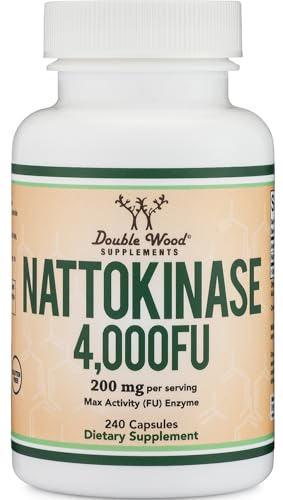
As an Amazon Associate we earn from qualifying purchases. Nattokinase is sold on an enzymatic activity claim, and independent testing has repeatedly found bottles delivering well under their labelled potency. Check that the label states fibrinolytic units (FU) per capsule rather than milligrams alone, and prefer a brand that will supply a batch-specific certificate of analysis showing the measured FU result for that lot, since GMP certification alone does not verify it.
A Note on the Evidence
The human research base for nattokinase’s effects on blood viscosity and hemorheological parameters is limited to a small number of studies, with [1] representing the primary focused investigation in this area; larger, independently replicated trials are needed before firm conclusions can be drawn. Nattokinase has real fibrinolytic and antiplatelet activity that creates meaningful bleeding risk when combined with anticoagulants, antiplatelets, or in people with clotting disorders — consult a qualified healthcare provider before use, particularly if you take any prescription medications or have a cardiovascular or hematological condition.

Frequently Asked Questions
What is blood viscosity and why would nattokinase affect it?
Blood viscosity describes how thick and resistant to flow blood is. Nattokinase degrades fibrinogen — a plasma protein that promotes red blood cells to clump together (aggregate) — so in principle, lowering fibrinogen could reduce aggregation and viscosity, particularly at low flow rates. A study in Clinical Hemorheology and Microcirculation investigated exactly this relationship [1].

Is there a published study specifically on nattokinase and blood viscosity?
Yes. A 2006 paper in Clinical Hemorheology and Microcirculation examined the effects of nattokinase on red blood cell aggregation and whole blood viscosity [1]. This is the primary published work focusing on hemorheological parameters rather than cardiovascular endpoints more broadly. Replication in additional studies would strengthen the evidence.
How does red blood cell aggregation relate to cardiovascular health?
When red blood cells aggregate excessively into rouleaux, they flow less efficiently through small capillaries, which can reduce oxygen delivery to tissues. Elevated aggregation is observed in conditions associated with high fibrinogen levels, including inflammation and some metabolic disorders. Whether reducing aggregation pharmacologically translates into measurable cardiovascular benefit in healthy people has not been established in large trials.
Can nattokinase be taken alongside blood thinners?
No, not without physician supervision. Nattokinase has meaningful fibrinolytic and antiplatelet activity, and combining it with warfarin, heparin, aspirin, clopidogrel, or other anticoagulant or antiplatelet agents significantly increases the risk of uncontrolled bleeding. Anyone on such medications should discuss this with their doctor before considering nattokinase.
How strong is the overall evidence for nattokinase affecting blood viscosity?
The evidence is preliminary. The hemorheology study [1] provides a focused investigation of this mechanism, but it represents early-stage research. Human trials on nattokinase generally are small and short-term. Until larger, independently replicated, randomized controlled trials confirm hemorheological effects, conclusions should be held tentatively.
Who should avoid nattokinase entirely?
People taking anticoagulant or antiplatelet medications, those with bleeding disorders, people who have had a hemorrhagic stroke, and anyone scheduled for surgery or an invasive procedure should either avoid nattokinase or consult a physician before using it. It should be stopped at least one week before any surgical procedure. Pregnant or breastfeeding individuals should also seek medical advice before use, as safety data in these populations are lacking.
References
- Pais E et al. Effects of nattokinase, a pro-fibrinolytic enzyme, on red blood cell aggregation and whole blood viscosity. Clinical hemorheology and microcirculation (2006). PMID 16899918
These statements have not been evaluated by the Food and Drug Administration. This information is not intended to diagnose, treat, cure, or prevent any disease. Content is for informational purposes only and is not medical advice; consult a qualified healthcare provider before starting any supplement. As an Amazon Associate we earn from qualifying purchases.
