Natto — the pungent Japanese fermented soybean food — naturally contains two compounds that have attracted serious cardiovascular research interest: nattokinase, a fibrinolytic enzyme produced by Bacillus subtilis during fermentation, and vitamin K2 (primarily as menaquinone-7, or MK-7), a fat-soluble vitamin that activates proteins involved in directing calcium away from arteries and into bone. Because both originate in the same food and are often discussed together in the context of heart and vascular health, supplement manufacturers have begun combining them in single capsules marketed as a cardiovascular support stack.
This article explains what each compound does, the proposed reasoning behind pairing them, what combination products typically look like, and the honest limitations of the current evidence base. Neither nattokinase nor vitamin K2 is FDA-approved to treat, cure, or prevent any disease, and anyone on blood thinners, anticoagulants, or antiplatelet drugs should consult a physician before using nattokinase in any form.
Key Takeaways
- Nattokinase and vitamin K2 naturally co-occur in natto; combination supplements aim to deliver both without eating the fermented food directly.
- Nattokinase degrades fibrin and upregulates plasminogen activators; K2 activates proteins that inhibit arterial calcification and support bone mineralization — proposed complementary mechanisms, not a proven synergistic combination.
- No clinical trial has tested a nattokinase-K2 combination product directly; the stack rationale is built from separate ingredient evidence bases.
- Nattokinase must not be combined with warfarin, aspirin, clopidogrel, heparin, or other anticoagulants or antiplatelets without physician supervision, and should be stopped at least one week before surgery.
- The FDA has not evaluated nattokinase or K2 supplement combinations for treating or preventing any disease; this information is not medical advice.
What Nattokinase Does
Nattokinase is a serine protease — an enzyme that cleaves peptide bonds in proteins — extracted and concentrated from natto. Its primary studied action is fibrinolysis: it degrades fibrin, the mesh-like protein that forms the structural backbone of blood clots. Unlike pharmaceutical thrombolytics administered in emergency settings, nattokinase is taken orally in supplement form; research in human plasma and in small randomized trials suggests it survives digestion well enough to produce measurable fibrinolytic effects, though the clinical magnitude of those effects remains under study.
Beyond direct fibrin degradation, nattokinase appears to upregulate the body’s own plasminogen activators, proteins that convert inactive plasminogen into plasmin — the body’s natural clot-dissolving enzyme. Small, short-term human trials have also reported modest reductions in systolic and diastolic blood pressure, though study sizes have generally been in the tens of participants rather than the hundreds needed to draw firm conclusions. Because of its antiplatelet and fibrinolytic activity, nattokinase carries meaningful drug-interaction risk and must never be combined with warfarin, heparin, aspirin, clopidogrel, or other anticoagulants or antiplatelets without physician supervision. It should also be discontinued at least one week before any surgical procedure.
What Vitamin K2 Does
Vitamin K2 (menaquinone) is a fat-soluble vitamin distinct from vitamin K1 (phylloquinone), the form most abundant in green vegetables and primarily associated with blood coagulation. K2 exists in several subtypes named for their side-chain length; MK-4 and MK-7 are the forms most studied in humans. The key difference between K1 and K2 in supplemental contexts is tissue distribution: K2, especially MK-7, has a longer plasma half-life and is thought to reach extrahepatic tissues — notably the arteries and bones — more effectively than K1.


Vitamin K2 functions as a cofactor for an enzyme called gamma-glutamyl carboxylase, which activates vitamin K-dependent proteins by adding carboxyl groups to specific glutamic acid residues. Two of these proteins are particularly relevant to cardiovascular and bone health: matrix Gla protein (MGP), which when activated inhibits calcium deposition in arterial walls, and osteocalcin, which when activated facilitates calcium binding in bone matrix. The popular shorthand is that K2 helps ‘route calcium to bone and away from arteries,’ though this framing oversimplifies a complex regulatory system. Population studies and some intervention trials have associated higher dietary K2 intake with reduced arterial calcification and improved bone mineral density, but the evidence is strongest for bone outcomes and more preliminary for vascular endpoints.
Why These Two Are Stacked Together
The rationale for combining nattokinase and vitamin K2 rests on a few converging observations. First, both compounds come from the same food source — natto — so pairing them in supplement form is presented as a way to replicate or concentrate what someone would get from eating natto regularly without the strong flavor and texture that limits its appeal in Western markets. Second, the proposed mechanisms are framed as complementary rather than redundant: nattokinase is said to address existing fibrin buildup and clot risk, while K2 is said to address longer-term arterial calcification risk. Third, MK-7 specifically is a metabolic byproduct of Bacillus subtilis fermentation, meaning it is produced by the same bacterial process that generates nattokinase — reinforcing the ‘natural co-occurrence’ narrative.
There is no published clinical trial, to the authors’ knowledge, that has specifically tested a nattokinase-plus-K2 combination product against a control group. The stack rationale is built from the individual evidence bases of each ingredient taken separately, not from combination trial data. Supplement companies are permitted to market such products under DSHEA rules in the United States as long as they do not make disease treatment claims, but this regulatory pathway does not require them to demonstrate that the combination provides additional benefit over either ingredient alone.
What Combination Products Look Like
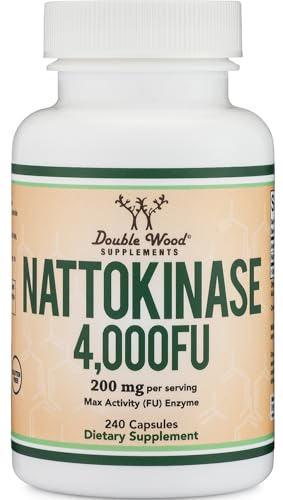
Most nattokinase-K2 combination capsules on the market pair nattokinase measured in fibrinolytic activity units (FUs) — commonly 2,000 to 4,000 FUs per serving — with MK-7 at doses typically ranging from 100 to 200 micrograms. Some formulations add vitamin D3 alongside K2, since D3 and K2 are frequently positioned together in bone and cardiovascular health contexts (D3 promotes calcium absorption while K2 is thought to direct that calcium appropriately). Others add magnesium, CoQ10, or garlic extract, reflecting the broader cardiovascular supplement category.

Enzyme activity units matter more than milligram weights for nattokinase because the enzyme’s potency depends on its ability to break down fibrin, not simply on mass. A product listing ‘100 mg nattokinase’ without an FU designation is harder to evaluate than one listing ‘2,000 FU.’ For K2, MK-7 at 100 to 200 micrograms is consistent with the doses used in most published bone and vascular research. Quality indicators to look for include third-party testing certification (USP, NSF, or Informed Sport) and clear disclosure of the nattokinase source strain and activity standardization.
Important Safety Considerations for the Stack
Nattokinase carries the more significant safety considerations of the two. Its fibrinolytic and antiplatelet activity makes it potentially dangerous for individuals on blood-thinning medications. Warfarin users face a double risk: nattokinase can potentiate warfarin’s anticoagulant effect while vitamin K2, like K1, can in theory interfere with warfarin’s mechanism (which works by blocking vitamin K-dependent clotting factor synthesis). The net effect of this combination in someone on warfarin is unpredictable and potentially serious, making physician supervision non-negotiable for that population. Those on aspirin, clopidogrel, heparin, apixaban, rivaroxaban, or any other antiplatelet or anticoagulant therapy should similarly consult their prescribing physician before adding nattokinase.
Vitamin K2 alone is generally considered safe at supplemental doses and has a favorable tolerability profile in most adults. However, the assumption that K2 does not affect INR the way K1 does is not fully settled — very high intakes of any vitamin K form can potentially affect clotting factor synthesis to some degree. Pregnant or breastfeeding individuals should seek medical guidance before supplementing with either ingredient. As with any supplement taken perioperatively, nattokinase should be stopped at least one week before any scheduled surgery due to its effects on clot formation.
Honest Assessment of the Evidence
The evidence base for each ingredient individually is real but limited. Nattokinase human trials are generally small (often 30 to 100 participants), short in duration (weeks to a few months), and heterogeneous in dosing and outcome measures. The fibrinolytic mechanism is well-characterized biochemically and in plasma studies, and blood pressure reductions in available trials are statistically significant in some studies, but there are no large, long-term cardiovascular outcomes trials demonstrating reduced rates of heart attack or stroke. This is a meaningful gap between biological plausibility and demonstrated clinical benefit.
Vitamin K2 has a somewhat larger evidence base for bone health, with several randomized trials supporting effects on bone mineral density and fracture risk in specific populations, particularly postmenopausal women. The arterial calcification data — arguably the more exciting claim — is more preliminary in humans, with much of the evidence coming from observational studies and surrogate-endpoint trials rather than hard cardiovascular outcomes data. The combination stack, as noted, has no dedicated clinical trial evidence at all; any benefit claim rests entirely on extrapolation from the individual ingredient literature.

🛒 Where to Buy Nattokinase
- Doctor’s Best Nattokinase 2,000 FULab-tested / studied
capsules, 100 mg NSK-SD per vcap (2,000 FU) — Most widely referenced brand in clinical and integrative medicine contexts; uses Japan Bio Science Laboratory NSK-SD ingredient; vegetarian capsules; 90 count - NOW Foods Nattokinase 100 mg
capsules, 100 mg per vcap (2,000 FU) — Mainstream GMP-certified brand; affordable entry-level option; 90 vcaps; widely available - Source Naturals Nattokinase 100 mg
capsules, 100 mg per tablet (2,000 FU) — Long-established supplement brand; competitive pricing at 60 tablets; good for budget-conscious buyers familiar with the brand - Healthy Origins Nattokinase 2,000 FU
capsules, 100 mg per vcap (2,000 FU) — Best cost-per-serving option on Amazon; 180 vcap bottle; uses NSK-SD ingredient; popular bulk buy for long-term users
As an Amazon Associate we earn from qualifying purchases. Nattokinase is sold on an enzymatic activity claim, and independent testing has repeatedly found bottles delivering well under their labelled potency. Check that the label states fibrinolytic units (FU) per capsule rather than milligrams alone, and prefer a brand that will supply a batch-specific certificate of analysis showing the measured FU result for that lot, since GMP certification alone does not verify it.
A Note on the Evidence
Most human trials supporting nattokinase’s fibrinolytic and blood pressure effects are small and short-term; no large outcomes trials exist, and no combination nattokinase-K2 product has been tested in a clinical trial. Nattokinase carries serious drug-interaction risk with all anticoagulant and antiplatelet medications and must be stopped before surgery; anyone on prescription medications or with a clotting disorder should consult a physician before use.
Frequently Asked Questions
Does natto naturally contain both nattokinase and vitamin K2?
Yes. Both compounds are produced during the Bacillus subtilis fermentation of soybeans. Nattokinase is the enzyme generated by the bacteria, and MK-7 is a menaquinone byproduct of the same fermentation process. This co-occurrence is the biological basis for marketing the two together in supplement form.

Is MK-7 or MK-4 better to pair with nattokinase?
Most combination products use MK-7 because it has a longer plasma half-life than MK-4 — estimated at 72 hours versus a few hours — which means a single daily dose can maintain more consistent tissue levels. MK-7 is also the form found in natto, making it the more directly relevant form for a natto-inspired stack. That said, both forms activate the same vitamin K-dependent proteins.
Can I take nattokinase and K2 if I am on a blood thinner?
No, not without explicit physician supervision. Nattokinase has fibrinolytic and antiplatelet activity that can potentiate the effects of warfarin, heparin, aspirin, clopidogrel, and newer anticoagulants. Vitamin K2 can also theoretically affect vitamin K-dependent clotting factor synthesis. The combination introduces unpredictable anticoagulation risk in someone already on prescribed blood thinners.
How much nattokinase is typically in a combination product?
Most products provide 2,000 to 4,000 fibrinolytic units (FUs) of nattokinase per serving, paired with 100 to 200 micrograms of MK-7. Activity units (FUs) are a more meaningful measure of potency than milligrams alone because nattokinase efficacy depends on enzymatic activity, not mass.
Does vitamin K2 make nattokinase less effective because K2 supports clotting factors?
This is a reasonable question but the mechanism concern is overstated at supplemental doses. Vitamin K2 activates clotting factors at very high intakes, but at typical supplement doses of 100 to 200 micrograms its primary measurable effects appear in extrahepatic tissues (arteries and bone) rather than liver-derived clotting factors. Nattokinase acts on fibrin and plasminogen activators through a separate pathway. The two are not directly antagonistic in healthy individuals at supplemental doses, but the interaction has not been formally studied.
Should I stop nattokinase before having surgery or a dental procedure?
Yes. Because of its fibrinolytic and antiplatelet activity, nattokinase should be discontinued at least one week before any surgical or invasive dental procedure to reduce the risk of excessive bleeding. Inform your surgeon or dentist about all supplements you are taking, including nattokinase.

These statements have not been evaluated by the Food and Drug Administration. This information is not intended to diagnose, treat, cure, or prevent any disease. Content is for informational purposes only and is not medical advice; consult a qualified healthcare provider before starting any supplement. As an Amazon Associate we earn from qualifying purchases.
